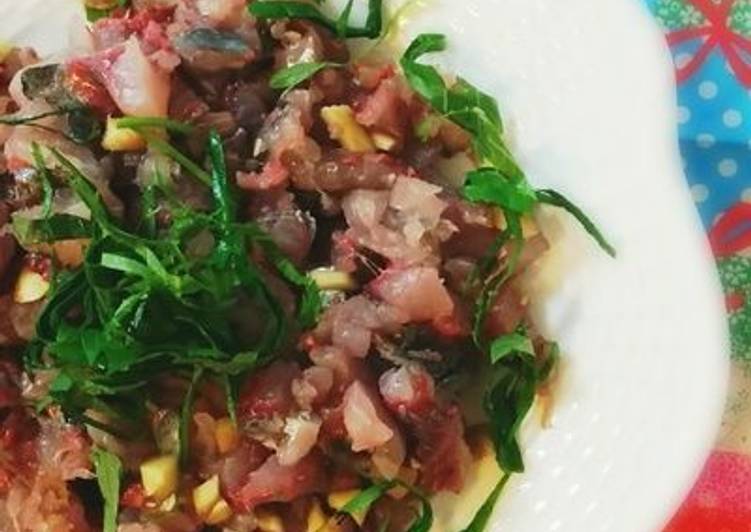
Hey everyone, hope you’re having an amazing day today. Today, I will show you a way to prepare a distinctive dish, aji no tataki (chopped horse mackerel sashimi). One of my favorites food recipes. For mine, I will make it a little bit tasty. This is gonna smell and look delicious.
Aji is horse mackerel in Japanese and a kind of fish which you find easily in Japan. Aji no Tataki is another Sashimi dish made with Tataki method. Fresh Aji is fillet in three pieces and finely chopped with chopped green onion.
Aji no Tataki (Chopped Horse Mackerel Sashimi) is one of the most favored of current trending meals on earth. It is enjoyed by millions daily. It’s simple, it is fast, it tastes yummy. Aji no Tataki (Chopped Horse Mackerel Sashimi) is something which I have loved my whole life. They’re nice and they look fantastic.
Recipe of Aji no Tataki (Chopped Horse Mackerel Sashimi)
To begin with this particular recipe, we have to first prepare a few components. You can have aji no tataki (chopped horse mackerel sashimi) using 3 ingredients and 4 steps. Here is how you can achieve that.
Ingredients
The ingredients needed to make Aji no Tataki (Chopped Horse Mackerel Sashimi):
- Make ready 4 fillets sashimi-grade horse mackerel ("aji")
- Make ready 1 chunk ginger, sliced
- Prepare 4 green shiso leaves, sliced thin
Aji Tataki/Horse mackerel Tartare served at Sushi Ko, Shizuoka City Sashimi, as almost everyone knows means thin Sashimi, as almost everyone knows means thin slices, whether it be fish, meat or vegetables. The seaweed can be used in soup or finely chopped and mixed in steamed rice later! Aji - ah-jee) - Horse mackerel, Jack Mackerel (less fishy tasting than Spanish mackerel). Purportedly this is not actually a mackerel, but member of the Tataki - tah-tah-kee) - Tataki is a Japanese term which may mean seared on the outside only (as in Katsuo) or chopped up and served in its raw form.
Instructions
Steps to make Aji no Tataki (Chopped Horse Mackerel Sashimi):
- Fillet the fish and remove the skin. Remove the bones if you don't like them. Chop the fish.
- Put the sliced ginger on the top of chopped horse mackerel and keep chopping, but do not chop too much.
- Then serve on a plate and decorate with sliced shiso leaves. Season with soy sauce.
- note: It is also good to add Myoga ginger, too.
But in the case of yellowtail (horse mackerel), you often get much larger pieces of the flesh mixed with chopped shallots (scallions), ginger, etc and piled My Japanese-style kingfish Tartare, called Kingfish Tataki is a similar dish to fish tartare but with miso flavour. The fish is chopped much more finely than. In the first "tataki" method, the meat or fish is seared very briefly over a hot flame or in a pan, and can be briefly marinated in vinegar, sliced thin, and seasoned with ginger Fish such as tuna or horse mackerel are chopped and mixed with garnishes such as garlic, ginger, green onions or shiso leaves. Aji is a popular and inexpensive fish that can be found in the waters around Japan, Korean, and China. Yellowtail is a leaner, milder and slightly creamy tasting fish that comes into season during the early summer.
As simple as that Recipe of Aji no Tataki (Chopped Horse Mackerel Sashimi)
So that is going to wrap this up with this special food aji no tataki (chopped horse mackerel sashimi) recipe. Thanks so much for your time. I am confident that you can make this at home. There’s gonna be more interesting food in home recipes coming up. Remember to bookmark this page in your browser, and share it to your loved ones, friends and colleague. Thank you for reading. Go on get cooking!
Print this page